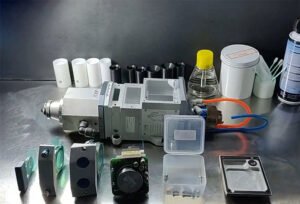
The global laser equipment market is expanding at an unprecedented pace. From automotive manufacturing to semiconductor fabrication, lasers have become indispensable tools across virtually every industrial sector. But here’s the truth that many distributors overlook: the real profit engine isn’t in selling the machines—it’s in keeping them running.
Laser spare parts distribution represents a high-margin, recurring-revenue opportunity that dwarfs the one-time sale of capital equipment. With the aftermarket segment already accounting for 45–50% of the total laser components market by value—and rising steadily as the installed base of hundreds of thousands of laser machines enters peak replacement cycles—the question isn’t whether to build a parts distribution network, but how to build one that dominates .
In this guide, I’ll walk you through the strategic framework for building a laser parts distribution network that captures B2B clients, drives recurring revenue, and positions your business as the go-to source for laser components wholesale.
1. Understand the Market Opportunity
Before building your network, you need to understand the scale and structure of the opportunity.
✅ The Numbers Don’t Lie
The global laser crystals and components market was valued at USD 1.25 billion in 2024 and is projected to reach USD 2.45 billion by 2032, growing at a CAGR of 8.8% . But this figure only tells part of the story.
Component replacement cycles range from 3–5 years for consumables (pump diodes, protective windows, nozzles) to 6–8 years for core subsystems (resonators, power supplies) . This creates a predictable, recurring revenue stream for distributors who position themselves correctly.
✅ Where the Demand Lives
Your target customers fall into three primary segments:
| Segment | Characteristics | Key Needs |
|---|---|---|
| Laser Manufacturers (OEMs) | Build and integrate laser systems | Reliable component sourcing, technical support, consistent quality |
| Equipment Distributors | Resell laser machines | After-sales support, parts availability, warranty fulfillment |
| Industrial End-Users | Operate laser systems daily | Rapid replacement, minimal downtime, cost optimization |
Industrial automation alone accounts for 40–50% of component demand, driven heavily by metal cutting and welding applications in automotive, heavy machinery, and structural fabrication . Meanwhile, semiconductor and precision manufacturing—the fastest-growing segment at 12–15% annually—presents the highest-value opportunity, with components requiring stringent cleanliness and beam-quality specifications commanding premium pricing.
2. Build Your Supplier Network: Sourcing Strategies
A distribution network is only as strong as its supply chain. Here’s how to build one that delivers on quality, price, and reliability.
✅ Regional Sourcing Strengths
China remains the world’s dominant manufacturing hub for laser components, with distinct regional specializations:
- Guangdong Province (Shenzhen, Dongguan): Excellence in control systems, servo motors, and sensor assemblies—ideal for electronics-integrated components.
- Shandong Province (Jinan, Qingdao): Heavy industrial manufacturing, CNC frames, linear guides, and large-scale structural components. Jinan has emerged as a center for domestic laser technology R&D.
- Beijing-Tianjin Corridor: Government-backed innovation with high-end machining capabilities, serving aerospace and automotive clients.
Germany (Ruhr Valley) offers ultra-high-tolerance machining with full EU compliance—ideal for medical or defense applications at a premium price point .
Vietnam is emerging as a low-cost alternative with improving quality controls, best suited for non-critical wear parts like brackets and basic nozzles .
✅ Supplier Evaluation Criteria
Price is just the starting point. To build a network your clients trust, evaluate suppliers against these benchmarks :
- Quality Certifications: Prioritize ISO 9001, IATF 16949, or AS9100—indicators of standardized quality management systems.
- Material Traceability: Demand mill test reports for metals and optical-grade documentation for lenses and mirrors.
- Wear Resistance Testing: For consumables like nozzles and focus lenses, verify adherence to ASTM G133 or ISO 11553.
- Production Scalability: Assess factory size, CNC fleet count, and automation levels.
✅ Performance Metrics That Protect Your Clients
When vetting potential suppliers, use these quantifiable KPIs:
| Metric | Benchmark | Why It Matters |
|---|---|---|
| On-Time Delivery Rate | ≥95% | Ensures your clients’ production continuity |
| First-Pass Yield Ratio | ≥98% | Indicates precision and minimal rework |
| Response Time | ≤4 hours | Critical for urgent RFQs and troubleshooting |
| Compliance Documentation | RoHS, REACH, CE | Required for customs clearance and market access |
3. Design Your Product Portfolio Strategy
Not all parts are created equal. A profitable distribution network requires strategic product selection and positioning.
✅ Know Your Component Tiers
| Tier | Component Types | Margin Profile | Strategy |
|---|---|---|---|
| High-Frequency Consumables | Nozzles, protective windows, lenses | High-margin, high-volume | Price competitively; build loyalty through reliability |
| Critical Subsystems | Resonators, power supplies, scanning heads | High-margin, lower-volume | Emphasize technical support and quality certification |
| Precision Optics | Fast-axis collimators, beam combiners, specialty coatings | Premium margin | Differentiate on technical specs; serve semiconductor and medical niches |
✅ The Pricing Opportunity
The laser components market shows a widening price bifurcation between standard and precision grades . Standard commercial-grade components are declining at 3–5% per year, while precision-grade components command a 30–40% price premium with limited price erosion—creating a clear opportunity for distributors who can validate and supply high-spec parts .
For example, a typical set of collimation and focusing optics for a 1 kW fiber laser may range from ¥1,500–3,000 in standard configuration, whereas a precision-grade equivalent with high-damage-threshold coatings can cost ¥4,000–8,000 .
4. Go-to-Market: Positioning for B2B Clients
Distribution isn’t about moving boxes—it’s about solving problems. Your marketing and sales approach must reflect this.
✅ Align Content with the B2B Customer Journey
B2B buyers—particularly technical decision-makers like production managers, engineers, and procurement teams—conduct extensive research before purchasing. Structure your content strategy accordingly :
- Awareness Stage: Educational content on laser technology, automation trends, and industry applications to build brand recognition.
- Consideration Stage: In-depth product explanations, comparison articles, and guidance on selecting components for specific applications.
- Evaluation Stage: Case studies, testimonials, application videos, and expert-level technical content to strengthen credibility.
- Conversion Stage: Clear calls-to-action, consultation requests, and expedited sample processes.
✅ Leverage AI Visibility
Search behavior is shifting toward AI-powered platforms that synthesize answers rather than listing search results . To capture this emerging channel :
- Structure content clearly and technically with schema markup
- Build topic clusters around core product categories
- Ensure technical accuracy and authority—AI systems prioritize trustworthy, well-structured information
- Consider listings on specialized photonics and laser industry platforms that are frequently referenced by AI systems
✅ Localized Customer Support
Leading distributors are winning by decentralizing their sales organizations. Establishing regional teams provides :
- Customer proximity for faster response times
- Application-specific solutions based on local industry needs
- Early market trend insights for proactive positioning
5. Logistics, Inventory, and Operational Excellence
A profitable distribution network requires operational discipline.
✅ Inventory Strategy
Given replacement cycle predictability :
- Stock high-frequency consumables (nozzles, protective windows) in volume
- Maintain buffer inventory for critical subsystems to offer rapid replacement
- Use ERP integration to trigger reorders automatically when stock reaches thresholds
✅ Quality Verification Protocol
Build trust through rigorous quality control :
- Order initial samples to test fitment and durability
- Use coordinate measuring machines (CMM) or optical comparators for dimensional validation
- Conduct accelerated life testing on high-power-rated consumables
- Secure payment terms (Trade Assurance, escrow) to protect against quality issues
✅ Lead Time Management
Standard items typically ship within 7–15 days from suppliers; customized optics may take 20–30 days . Communicate these timelines clearly to clients and offer expedited options for emergency replacements.
6. Build Long-Term Relationships
In distribution, relationships are everything. Your clients need to trust that you’ll deliver quality parts when they’re needed most.
✅ What Top Distributors Do Differently
- Provide technical support—help clients select the right components for their specific applications
- Offer verification documentation—material certifications, test reports, and compliance paperwork
- Enable sample testing—allow clients to validate compatibility before volume purchases
- Negotiate tiered pricing—leverage volume projections for better rates and pass savings to loyal clients
- Diversify supplier base—qualify two suppliers per component category (one primary, one backup) to protect against supply shocks
Conclusion
Building a profitable laser spare parts distribution network isn’t about having the lowest prices. It’s about becoming the most reliable partner your B2B clients can count on—the one who understands their technical requirements, delivers consistent quality, and ensures they never face unplanned downtime.
The market is growing. The aftermarket segment is expanding. And the window of opportunity is wide open for distributors who build their networks with strategy, quality, and client relationships at the center.
Start building yours today.