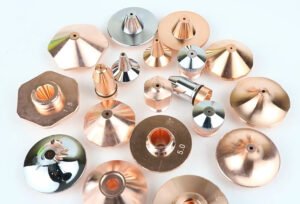
In precision manufacturing, the quality of laser consumables—nozzles, protective lenses, focusing optics, and ceramic holders—directly determines your machine’s cutting performance and operational uptime. Yet many B2B procurement professionals focus primarily on price when selecting a supplier, overlooking critical factors that can cost far more in downtime, scrap, and lost productivity.
For laser manufacturers, equipment suppliers, and parts distributors, asking the right questions before committing to a supplier partnership is essential. This article outlines five key questions that form a practical laser parts supplier checklist, helping you evaluate technical capability, operational reliability, and long-term value.
Introduction: Why Supplier Selection Matters
The laser consumables market is crowded with options—from OEM suppliers offering guaranteed compatibility to aftermarket manufacturers providing cost-effective alternatives. But not all suppliers are created equal.
A 2025 B2B sourcing analysis reveals that top-performing suppliers maintain on-time delivery rates above 95% and reorder rates exceeding 25%—metrics that indicate both operational maturity and customer satisfaction. Meanwhile, suppliers with poor quality control can turn a routine maintenance task into a production nightmare, with hidden costs far exceeding the initial part price.
To avoid these pitfalls, procurement managers should apply a structured evaluation framework. The five questions below cover the essential dimensions of supplier reliability: inventory depth, technical expertise, quality assurance, emergency support, and total cost transparency.
Question 1: How Deep Is Your Inventory Across Different Laser Brands and Generations?
Many manufacturing facilities run a mix of equipment—older CO₂ systems alongside newer fiber lasers, with components that are not interchangeable. A supplier with comprehensive inventory coverage eliminates the need to maintain relationships with multiple vendors, reducing administrative overhead and simplifying emergency sourcing.
✅ What to look for:
- Cross-brand compatibility: Does the supplier stock components for multiple major brands (Precitec, Raytools, WSX, Amada) and across different laser generations?
- Legacy component availability: Laser manufacturers frequently update designs, but older systems remain operational for years. A supplier with deep inventory in legacy parts can keep your older machines running while you plan equipment upgrades.
- Regional sourcing advantages: Suppliers in specialized industrial zones—such as China’s Yangtze River Delta for precision optics or Guangdong for electronics integration—often offer better availability and shorter lead times.
✅ Red Flags to Watch For
- Limited product range focusing on only one brand or generation
- Inability to provide dimensional drawings or compatibility documentation
- Long lead times (over 7 days) for common consumables
Question 2: What Technical Expertise Can You Offer Beyond Part Numbers?
The difference between a parts dealer and a true partner becomes clear when something goes wrong. A supplier with hands-on repair and manufacturing experience brings diagnostic capabilities that can save significant time and money.
✅ What to look for:
- Diagnostic support: Can the supplier help determine whether a failing component is the actual problem or just a symptom of a larger issue? This expertise prevents the costly mistake of replacing parts that aren’t actually defective.
- Preventive maintenance recommendations: Experienced suppliers can recommend maintenance schedules based on actual field experience, not just manufacturer guidelines.
- Application-specific knowledge: Different materials and processes require different consumable specifications. For example, cutting high-carbon steel (C > 0.6%) requires different nozzle and gas settings than low-carbon steel.
✅ Questions to Ask
- Do you have in-house engineers who understand laser optics and gas dynamics?
- Can you provide technical documentation, including material certificates and test reports?
- Have you worked with applications similar to mine (e.g., automotive, aerospace, medical)?
Question 3: What Quality Assurance Processes Do You Have in Place?
Consumable quality directly affects cutting performance. Poor-quality nozzles with off-spec inner diameters or concentricity can cause turbulent gas flow and dross formation. Likewise, contaminated or scratched protective lenses degrade beam transmission and can damage internal optics.
✅ What to look for:
- Certifications: ISO 9001 is the baseline; IATF 16949 (automotive) or AS9100 (aerospace) indicate higher quality standards.
- Material traceability: For metals, demand mill test reports. For optics, request transmittance test reports and coating specifications.
- Inspection capabilities: Suppliers with in-line CMM (coordinate measuring machine) checks and documented QC workflows demonstrate commitment to dimensional accuracy.
- Sample validation: Most reputable suppliers offer sample units for testing before bulk orders. Use this opportunity to evaluate kerf width consistency, edge quality, and component wear after 50 hours of operation.
✅ Red Flags to Watch For
- Vague or absent quality documentation
- Reluctance to provide samples or test reports
- No third-party certifications
Question 4: How Do You Handle Emergency Support and Urgent Orders?
Production schedules don’t accommodate equipment failures. When a laser goes down during a critical production run, standard shipping timelines become unacceptable.
✅ What to look for:
- Safety stock: Does the supplier maintain significant inventory for fast-moving consumables?
- Response time: Leading suppliers respond to inquiries within 1–2 hours and maintain technical support teams for urgent calls outside normal business hours.
- Expedited shipping capability: Can the supplier commit to specific delivery timelines and follow through consistently?
✅ Performance Benchmarks
- On-time delivery rate ≥ 95% is the minimum acceptable benchmark
- Response time ≤ 2 hours indicates strong customer service priority
- Reorder rate > 25% suggests consistent quality and satisfaction
Question 5: What Is the Total Cost of Ownership—Beyond the Unit Price?
The cheapest nozzle or lens is rarely the most cost-effective option. When evaluating cost, consider the full picture.
✅ What to Include in Your Calculation
| Cost Component | Why It Matters |
|---|---|
| Downtime costs | Every hour of idle production has a measurable dollar value |
| Scrap and rework | Inconsistent cuts due to poor consumables lead to material waste |
| Consumable lifespan | Higher-quality lenses and nozzles last longer, reducing replacement frequency |
| Inventory carrying costs | Holding safety stock ties up capital |
| Expedited shipping fees | Emergency orders incur premium freight charges |
✅ Questions to Ask
- Do you offer consignment stocking or consignment inventory programs to reduce our carrying costs?
- What are your typical warranty terms and return policies?
- Can you provide data on average consumable lifespan under operating conditions similar to mine?
Conclusion: Building a Strategic Supplier Partnership
Selecting a laser consumables supplier is not a transaction—it’s a strategic decision that affects your operational reliability, product quality, and customer satisfaction. By asking these five questions, you can move beyond price comparisons and evaluate suppliers based on what truly matters: technical depth, quality assurance, and long-term partnership potential.
The best suppliers become an extension of your maintenance team. They understand your equipment mix, know your typical failure patterns, and can anticipate your needs before you call. In a competitive manufacturing environment, that kind of partnership is not just an advantage—it’s a necessity.