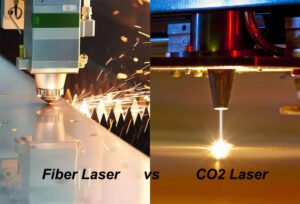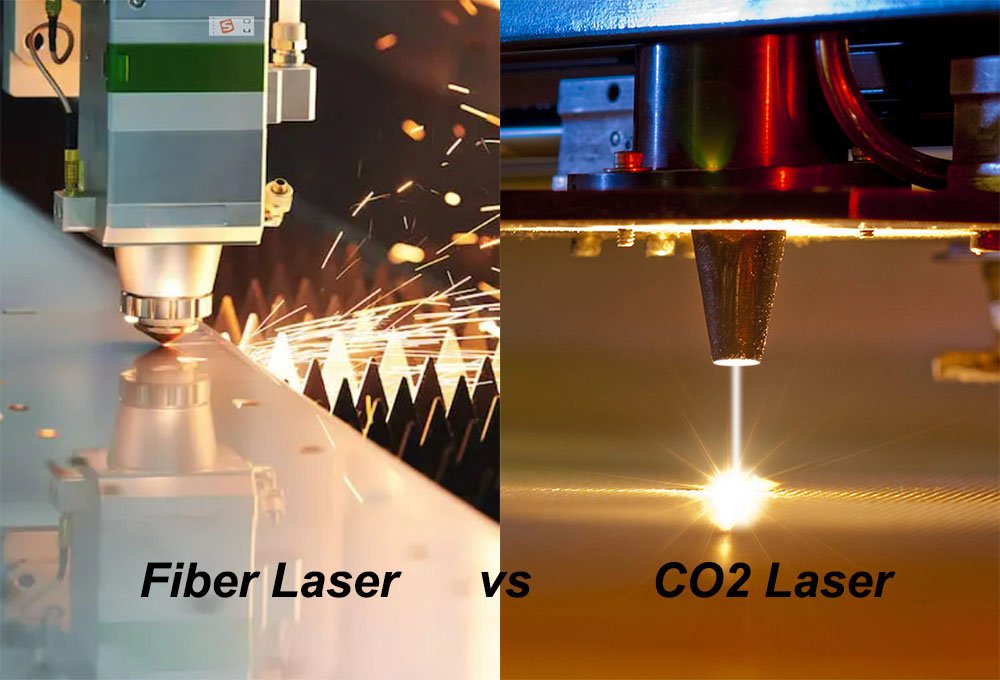
The debate between fiber and CO2 laser technology has largely been settled in the industrial sector. For B2B buyers—laser manufacturers, machinery dealers, and component distributors—the question is no longer if fiber lasers outperform CO2 lasers, but how their component architectures differ and what that means for your supply chain and customer offerings.
The Optical Architecture: A Tale of Two Systems
✅ CO2 Laser Components: The Complex Beam Path
CO2 lasers operate at a 10.6-micrometer wavelength and rely on an intricate network of optical components throughout the system.
Resonator Components:
- Resonator mirrors with high-reflectivity coatings
- Output couplers for beam extraction
- Gas circulation turbine to maintain uniform gas flow
- Vacuum pump for pressure stability
- Gas purification modules requiring helium, nitrogen, and CO2
Beam Delivery System:
- Multiple cooled steering mirrors positioned strategically to reflect and direct the beam
- Bellow systems to maintain beam path integrity
- Focusing lenses at the cutting head
This complex architecture means mirror cleaning and alignment are routine maintenance tasks, and bellows checks are necessary to prevent beam path contamination.
✅ Fiber Laser Components: Sealed and Simplified
Fiber lasers operate at approximately 1.06 micrometers—about one-tenth the wavelength of CO2—and feature a radically simplified component architecture.
Resonator Components:
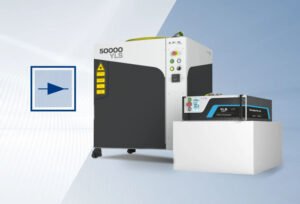
- Diode banks housed in compact, briefcase-sized modules
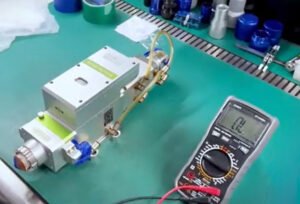
- Fiber-optic cable for beam delivery (no mirror routing)
- No gas medium, turbine, vacuum pump, or resonator alignment required
Cutting Head Optics (the only optics in the system):
- Protective windows (typically fused silica with AR coatings)
- Collimating optics for beam expansion
- Focusing lenses that concentrate the beam onto the workpiece
This sealed architecture means all optics are located in the cutting head only—no mirrors, output couplers, or cooled copper components elsewhere in the system.
Critical Component Comparison
| Component Category | CO2 Laser System | Fiber Laser System |
|---|---|---|
| Resonator Optics | Gas-filled cavity with multiple mirrors, output couplers | Solid-state diode banks, no resonator optics |
| Beam Delivery | Open path with 5-7 cooled steering mirrors | Sealed fiber-optic cable |
| Core Optical Elements | Lenses, mirrors, output couplers, bellow systems | Protective windows, collimators, focusing lenses (all in cutting head) |
| Wavelength | 10.6 µm | 1.03–1.08 µm |
| Electrical Efficiency | 8–12% | 30–45% |
| Cooling Demand | 60–90 kW (for 10kW class) | 15–30 kW (for 10kW class) |
| Annual Maintenance Downtime | 5–10% | <2% |
The Optics Quality Imperative for Fiber Lasers
The simplified architecture of fiber lasers does not mean easier maintenance—it actually demands a higher standard of optics quality and cleanliness that B2B suppliers must understand.
✅ Why Cleanliness Matters More
CO2 lenses can tolerate minor contamination and continue functioning. A fiber lens will not. A particulate smaller than a virus microbe can end the life of a fiber lens.
Key implications for component suppliers:
- Protective windows are essential, not optional—they protect the expensive focusing lens from debris
- Window quality directly affects cut quality—there is no substitute for high-grade fused silica with proper AR coatings
- Lens changing requires cleanroom conditions at higher power levels (3kW+), which has driven the industry toward sealed cutting heads
✅ Laser-Grade vs Commercial-Grade Optics
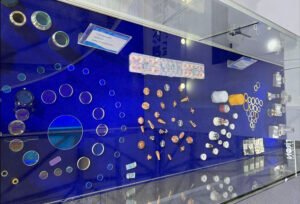
For buyers, understanding the distinction between laser-grade and commercial-grade optics is critical:
| Specification | Laser-Grade Optics | Commercial-Grade Optics |
|---|---|---|
| Surface Roughness | ≤1nm RMS | <3nm RMS |
| Scratch/Dig | 10/5 – 20/10 | 40/20 – 60/40 |
| Wavefront Accuracy | λ/4 or better | 1λ or λ/2 |
| Coating | High-damage-threshold for lasers | Standard AR or protective |
Laser Line Optics: Supplier Selection Criteria
For component distributors and OEMs sourcing optics for either platform, consider these technical specifications:
✅ Critical Specifications to Evaluate
1. Center Wavelength Match
- CO2: 10.6 µm (ZnSe optics typical)
- Fiber: 1.03–1.08 µm (fused silica preferred)
2. Laser-Induced Damage Threshold (LIDT)
- Verify whether spec is for CW or pulsed operation
- Critical for high-power fiber systems (3kW+)
3. Angle of Incidence (AOI)
- Narrowband coatings are highly sensitive to angular shifts
- A mirror designed for 0° AOI may fail at 45°
4. Substrate Choice
- BK7 acceptable for low-power visible/NIR
- Fused silica required for high-power or UV applications due to lower absorption and better thermal stability
5. Coating Quality
- V-coatings offer higher transmission at design wavelength than broadband AR coatings
- Ion-beam-sputtered (IBS) coatings provide superior durability
Economic Implications for Your B2B Customers
The component architecture differences translate directly to bottom-line impact for end users:
Annual Operating Cost Comparison (4kW Class)
| Cost Category | CO2 Laser | Fiber Laser |
|---|---|---|
| Helium (48 cylinders) | ~$8,000 | $0 |
| Nitrogen (24 cylinders) | ~$2,000 | $0 |
| CO2 gas | ~$150 | $0 |
| Electricity (annual) | ~$15,000 | ~$3,500 |
| Optics/Maintenance | ~$15,000 | ~$800 |
| TOTAL | ~$40,150 | ~$4,300 |
✅ Maintenance Interval Comparison
| Parameter | CO2 Laser | Fiber Laser |
|---|---|---|
| Service Interval | 3–6 months | 12–24 months |
| Turbine Overhaul | 12–24 months | Not applicable |
| Vacuum Pump Replacement | 3–5 years | Not applicable |
| Maintenance Labor Cost | High | 50–70% lower |
Strategic Takeaways for B2B Buyers
✅For Component Distributors
The fiber laser aftermarket represents a growing opportunity for high-quality protective windows and focusing lenses. The market is shifting toward sealed cutting heads, but the demand for consumable optics remains strong—with stricter quality requirements that command premium pricing.
✅For Laser Manufacturers
OEMs should consider the total cost of ownership advantage when specifying components for new systems. The simplified architecture of fiber lasers reduces parts count but increases the performance requirements for each optical component.
✅For Machinery Dealers
When advising customers on equipment purchases, emphasize that the total operating cost difference between CO2 and fiber systems can justify the upgrade within 2–3 years, even for retrofit projects.