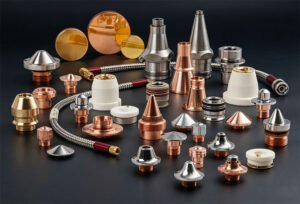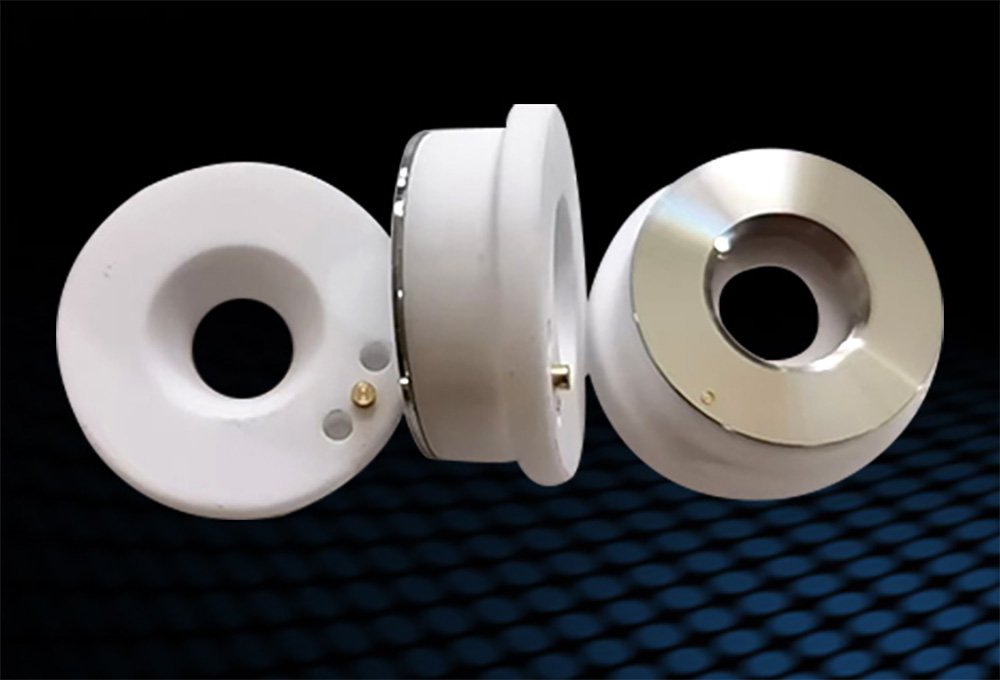
In fiber laser cutting systems, the ceramic ring is one of the most critical yet often overlooked consumable components. Installed between the nozzle and the cutting head body, this small ceramic component performs three essential functions: electrical insulation for capacitive height sensing, mechanical protection against collisions, and thermal stability during high-power operations.
For procurement professionals—laser manufacturers, machinery equipment suppliers, and parts distributors—selecting the correct ceramic ring is not merely a compatibility issue. It directly impacts cutting precision, machine uptime, and operational costs. A mismatched ceramic ring can cause unstable height control, frequent nozzle crashes, poor edge finish, and even damage to expensive cutting head components.
This guide provides a technical comparison of the three most common ceramic ring sizes—D28, D32, and D41—and offers selection criteria for different cutting head models and applications.
What Is a Laser Ceramic Ring?
A ceramic ring is a precision-machined component typically made from alumina (Al₂O₃, 95–99%) or ZTA (Zirconia-Toughened Alumina). It sits between the nozzle holder and the cutting head body, performing the following functions:
| Function | Description |
|---|---|
| Electrical Insulation | Provides stable dielectric properties for capacitive height sensing; prevents electrical arcing and signal interference |
| Mechanical Protection | Acts as a sacrificial buffer; absorbs impact energy during nozzle collisions to protect the cutting head |
| Thermal Stability | Withstands high-temperature, high-energy laser environments without deformation |
| Nozzle Alignment | Maintains coaxiality between the nozzle and optical axis for precise beam focusing |
Service life typically ranges from 1 to 15 days depending on cutting conditions, material thickness, and collision frequency.
D28 vs D32 vs D41: Technical Specifications
The naming convention for ceramic rings—D28, D32, D41—refers to the maximum outer diameter in millimeters. However, selecting the correct ring requires matching four critical parameters: outer diameter, lower diameter, height, and thread type.
✅ Comparison Table
| Parameter | D28 (Standard) | D32 | D41 |
|---|---|---|---|
| Maximum Outer Diameter | 28 mm | 32 mm | 41 mm |
| Lower Outer Diameter | 24.5 mm | 28–28.5 mm | 25 mm |
| Height | 12 mm | 12 mm | 34 mm |
| Thread | M11 | M14 | M11 |
| Compatible Heads | Raytools, Gangchun, WSX (some models) | Raytool/Bodor (larger), Precitec-compatible variants | BOCI, Ospri, WSX, Trumpf |
| Max Power Handling | Up to ~5,000 W | Varies by model | High-power applications |
✅ Key Differences
D28/M11 is the most common specification for Raytools-type cutting heads and standard-power laser systems. It features a 28 mm outer diameter with an M11 thread and 12 mm height.
D32/M14 offers a larger outer diameter (32 mm) with an M14 thread. Some variants have a 28.5 mm lower diameter and M12 thread for different head models. This size is typically used with higher-power Raytool/Bodor heads and specific Precitec-compatible systems.
D41/M11 is a taller ring (34 mm) with a 41 mm outer diameter and M11 thread. It is primarily used with BOCI, Ospri, and Trumpf cutting heads. The significantly greater height accommodates different sensor stack geometries and cooling requirements.
How to Select the Right Ceramic Ring
✅ 1. Identify the Cutting Head Brand and Model
The most reliable selection method is to match the ring to the specific cutting head model rather than size alone.
| Brand/Head Type | Compatible Ceramic Ring |
|---|---|
| Raytools (BT210, BT220, BT240, BM series) | D28/M11 standard; some models use D32/M14 |
| BOCI BLT series | D41/M11 |
| Ospri | D41/M11, D21.5/M8, D17.8/M8 |
| Precitec Procutter | D31/M11 variants |
| WSX | D41/M11, D28/M11, D24/M8 |
| Trumpf | D41, D31.8, D37.6 variants |
| IPG | D28.7/M11 |
✅ 2. Verify Thread Compatibility
Thread mismatch is a common cause of installation failure. The three standard threads are:
- M11 – Most common, used on D28, D41, and some D31 rings
- M14 – Used on D32 rings for Raytool/Bodor heads
- M12 – Used on certain D32 and D28 Trumpf-type rings
Critical: Do not select by outer diameter alone. A D28/M11 and D28/M12 ring have the same outer diameter but different threads, making them incompatible.
✅ 3. Consider Material Selection
| Material | Best For |
|---|---|
| Alumina (Al₂O₃ 95–99%) | Standard replacement; stable insulation; cost-effective |
| ZTA (Zirconia-Toughened Alumina) | High-impact environments; frequent nozzle changes; applications with edge chipping history |
ZTA (Zirconia-Toughened Alumina) High-impact environments; frequent nozzle changes; applications with edge chipping history
ZTA offers superior toughness and can reduce edge chipping risk in demanding maintenance environments.
✅ 4. Evaluate Dimensional Tolerances
High-quality ceramic rings maintain:
- OD/ID tolerance: ±0.05 mm
- Thickness tolerance: ±0.1 mm
- Concentricity: ≤0.10 mm
These tolerances ensure consistent sensor gap and nozzle coaxiality, which directly affect cutting accuracy.
Common Selection Mistakes to Avoid
Based on industry feedback, the most frequent errors in ceramic ring selection include:
- Using generic rings without checking dimensions – Causes improper seating and unstable height control
- Mixing Raytools ceramic rings with Precitec heads – Thread or height mismatches lead to sensor errors
- Selecting by outer diameter alone – Ignores critical thread and height parameters
- Reusing cracked or chipped rings – Leads to sensor failure and potential head damage
- Choosing low-cost rings with poor insulation – Can cause arc damage to expensive components
Maintenance Best Practices
For operators managing laser cutting fleets, extending ceramic ring life reduces consumable costs and downtime:
- Clean spatter regularly from the ceramic surface after each shift
- Avoid over-tightening during installation—follow torque specifications
- Replace rings after major nozzle collisions—even if no visible damage
- Store spare rings in dry, padded containers to prevent transit damage
Sourcing Considerations for B2B Buyers
When sourcing ceramic rings for resale or in-house use, consider:
| Factor | Why It Matters |
|---|---|
| OEM vs. aftermarket | OEM offers maximum stability; quality aftermarket (e.g., China AT) provides cost-effective alternatives for price-sensitive maintenance |
| Quality certification | Look for dielectric strength >15kV/mm and controlled sintering processes |
| Batch consistency | Ensures uniform dimensional tolerances across multiple orders |
| Supply reliability | Maintain inventory for high-consumption items (1–15 day service life) |
Conclusion
Selecting the correct ceramic ring—whether D28, D32, or D41—requires matching outer diameter, lower diameter, height, and thread to the specific cutting head model. While the D28/M11 is the industry standard for Raytools-type heads, the D32/M14 and D41/M11 serve higher-power applications and specific head brands like BOCI, Ospri, and Trumpf.
For procurement professionals, investing in high-quality ceramic rings with precise tolerances reduces unplanned downtime, protects expensive cutting head components, and maintains consistent cutting quality. Always verify compatibility using the old ring, drawing, or assembly photo before ordering.